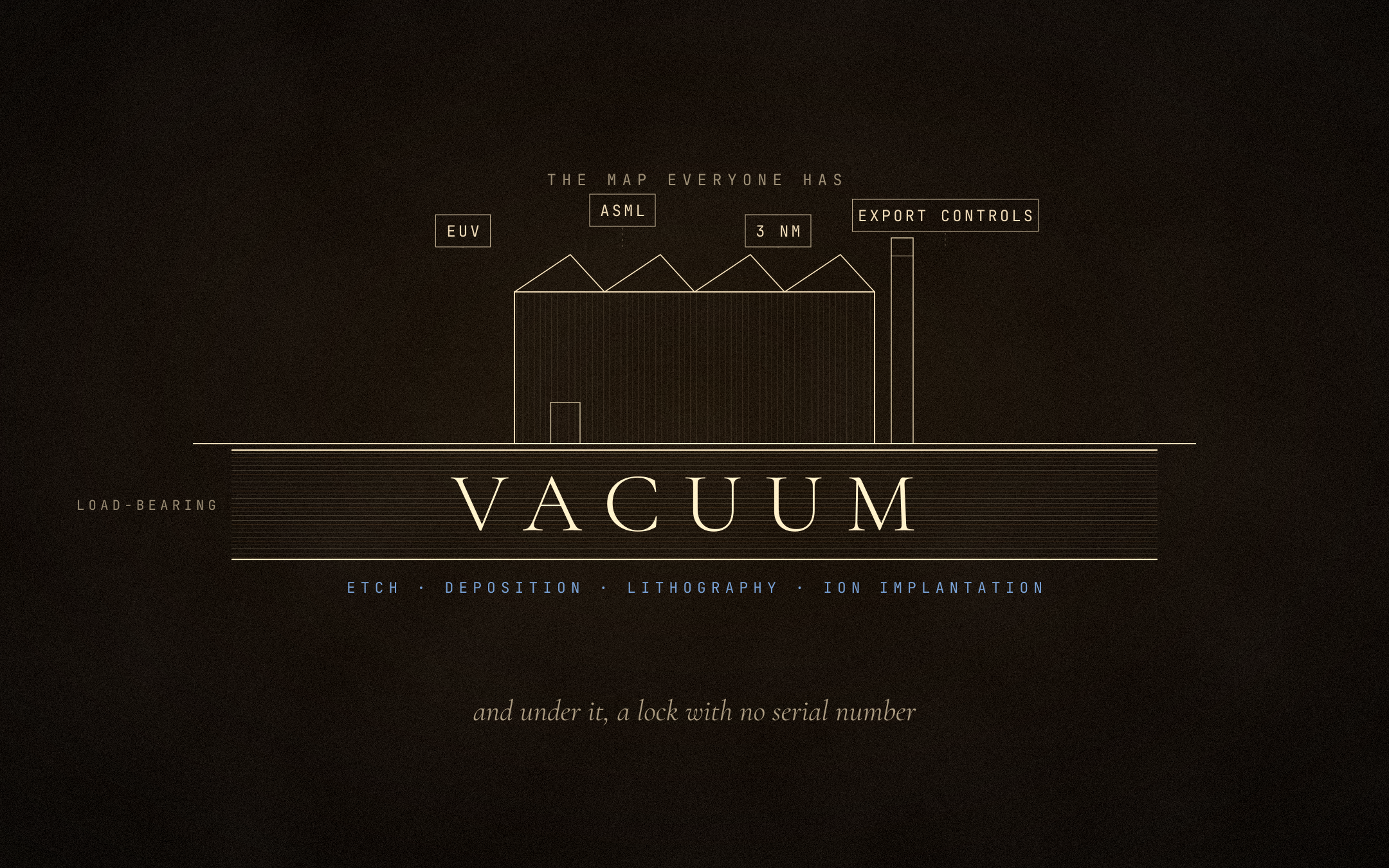
Everyone has a map of the chip war now.
The map has famous places on it. EUV. ASML. Taiwan. The 3-nanometer node. Export controls. The names are public, the stakes are public, the fight is on the front page. People who have never seen a wafer can tell you that one Dutch company makes the machine that prints the smallest chips, and that the United States is trying to keep that machine out of China.
That map is real. It is also incomplete. Under every place on it sits a layer that almost no one names.
Vacuum.
Not the household word. The discipline. Pumping a chamber down through more than ten orders of magnitude of pressure, holding it there, keeping it clean, for years. A chip is not made in air. A chip is made in near-emptiness.
The process is the vacuum
Walk the front end of a fab and count the steps that need a chamber pumped down. Almost all of them.
Deposition lays the thin films. Physical vapor deposition vaporizes a source inside a vacuum chamber and lets it condense on the wafer. Chemical vapor deposition feeds reactive gas at low pressure. Etching removes material with plasma, which only forms below atmospheric pressure. Ion implantation fires dopants down a vacuum beamline. Each layer of a modern chip is built and cut and doped this way, and a complex CMOS wafer runs the patterning cycle dozens of times before it is done.
- [B] HORIBA, semiconductor lithography process (a CMOS wafer can run the photolithographic cycle as many as 50 times), https://www.horiba.com/int/semiconductor/process/lithography/
Then there is the machine on everyone’s map. EUV. The light it uses is absorbed by ordinary matter, so the whole instrument has to live in vacuum. ASML says it plainly.
EUV light is absorbed by everything, even air. So the whole light path and everything the light interacts with, from source to wafer, must be in high vacuum.
- [A] ASML, EUV lithography systems, https://www.asml.com/en/products/euv-lithography-systems
Inside that source chamber, a high flow of hydrogen protects the collector mirror, and hydrogen is one of the hardest gases to pump. The pumps that do it are a product in their own right.
- [B] Pfeiffer Vacuum, vacuum solutions for EUV (high-flow dry pumps for hydrogen), https://www.pfeiffer-vacuum.com/global/en/markets/semiconductor/lithography/euv-lithography
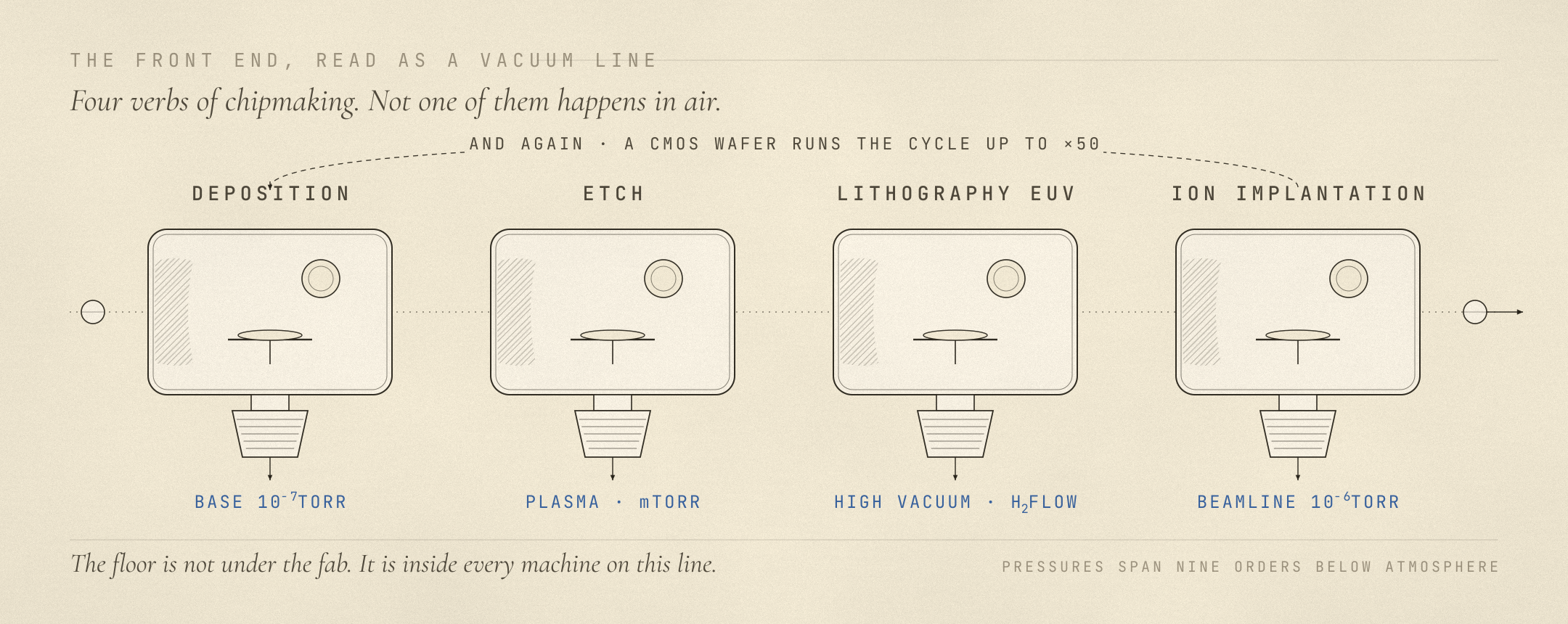
So the headline is true but shallow. The bottleneck is not only the light. The bottleneck is the emptiness the light needs. No vacuum, no chip.
Who makes the pumps
If vacuum is the floor under the fab, the next question is simple. Who builds the floor.
The market estimates disagree, and they disagree by a lot. One 2025 survey puts the top six pump makers at about 62 percent of the semiconductor vacuum pump market. Another puts a top five at 45 to 50 percent. A broader vacuum survey from 2023 puts a leading group at 25 to 30 percent. Three reports, three numbers. All of them are commercial, paywalled, and quiet about method.
- [C] Dataintelo, semiconductor vacuum pump market (top six ≈ 62%, 2025), https://dataintelo.com/report/semiconductor-vacuum-pump-market
- [C] Mordor Intelligence, vacuum pump market (top five ≈ 45–50%, 2025), https://www.mordorintelligence.com/industry-reports/vacuum-pump-market
- [C] GMInsights, vacuum pump market (leading group ≈ 25–30%, 2023), https://www.gminsights.com/industry-analysis/vacuum-pump-market
Do not lean on the percentage. Lean on the names. Because the names do not move.
Pull any of those rankings and the top of the list is the same short roster. Edwards, the dominant semiconductor vacuum brand, owned by Atlas Copco of Sweden, built in the UK. Pfeiffer, German, now inside Busch, German. Leybold, German. Ebara, Japanese. ULVAC, Japanese. Kashiyama, Osaka Vacuum, Canon Anelva, Japanese. The disagreement is about how to slice the share. The agreement is about the geography.
The ownership is on the record, in the companies’ own filings.
- [A] Atlas Copco (Stockholm, Sweden), completion of the Edwards acquisition (Edwards headquartered in the UK), https://www.atlascopcogroup.com/en/media/press-releases/2014/140109-edwards
- [A] Pfeiffer Vacuum / Busch Group (Pfeiffer based in Asslar, Germany; Busch Group headquartered in Germany’s Black Forest; Busch holds a majority stake), https://group.pfeiffer-vacuum.com/en/news-media/press-releases/three-strong-brands-form-the-global-busch-group/
- [A] Ebara Corporation, corporate outline (headquartered in Tokyo, Japan; semiconductor vacuum pumps and abatement), https://www.ebara.co.jp/en/about/corporate/about/outline/index.html
Germany. Japan. The UK and Sweden. That is the top tier.
Look at what is not in the top tier. No American maker leads it. No Chinese maker is near it. No Russian maker exists in it. The Chinese names that do appear sit in the fragmented tail of every survey, the long list after the short one.
This is the part worth sitting with. The country running the chip war does not make the floor the fab stands on. It buys it from allies. And the country the chip war is aimed at cannot make it either.
The control regime already knows
The export-control machinery has noticed, even if it never says the word.
When the United States moved to cut China off from advanced chipmaking, it did not write rules about “vacuum.” It wrote rules about tools. The October 2023 controls name the equipment by function. Etch. Deposition. Lithography. Ion implantation. Annealing. Metrology and inspection. Cleaning.
- [A] US Bureau of Industry and Security, Export Controls on Semiconductor Manufacturing Items, 88 Fed. Reg. 73424 (Oct. 25, 2023), https://www.federalregister.gov/documents/2023/10/25/2023-23049/export-controls-on-semiconductor-manufacturing-items
- [A] US BIS press release on the rule, https://www.bis.gov/press-release/commerce-strengthens-export-controls-restrict-chinas-capability-produce-advanced-semiconductors-military
Read that list again with a vacuum scientist’s eye. Etch is a vacuum process. Deposition is a vacuum process. Advanced lithography is a vacuum process. Ion implantation is a vacuum process. The control list is, in large part, a list of machines that cannot run without a pumped chamber. The state has drawn a fence around the vacuum frontier of the fab. It just labeled the fence by process, not by physics.
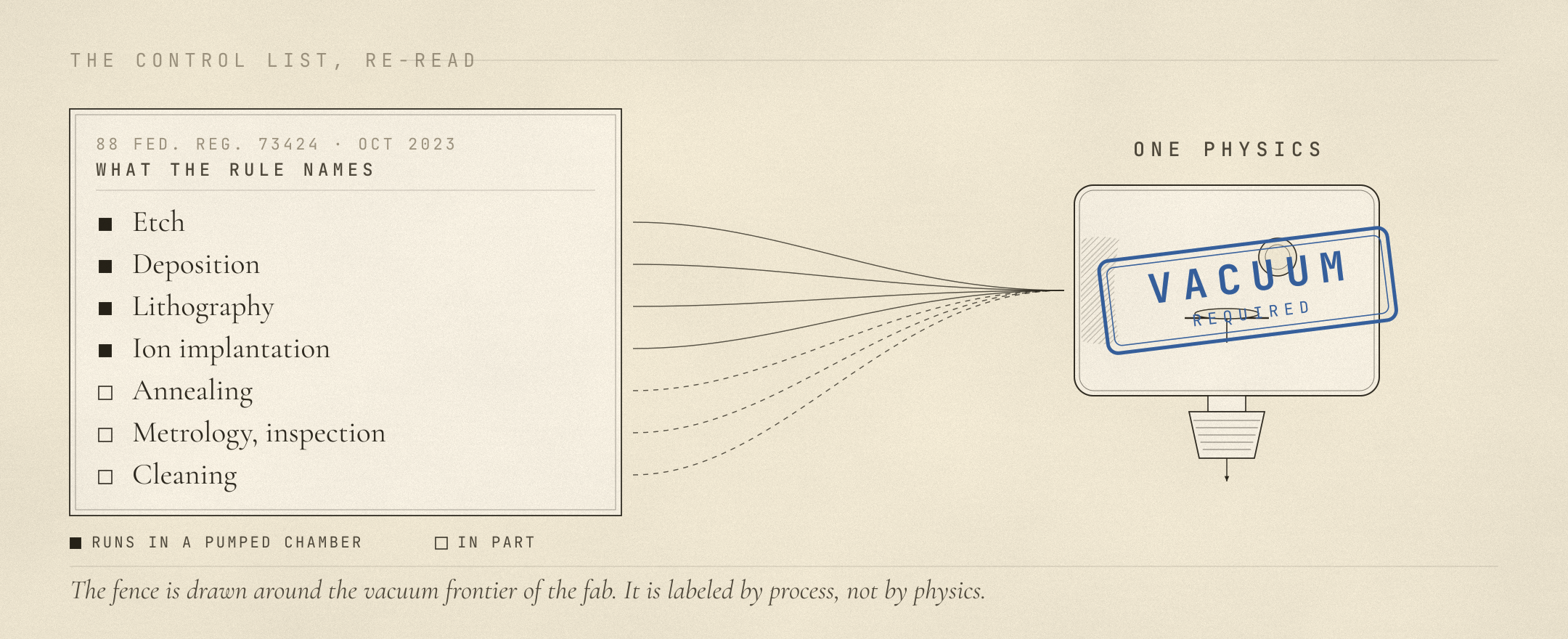
That is the tell. The strategic layer is being defended already. It is being defended without being named.
What this movement does not settle
Here is the limit of everything above. All of it is visible.
A pump has a serial number. A tool has a customs code. A factory has an address you can put under sanction. The lock described here is the lock you can see, count, and ship. It is the lock a government can act on.
It is not the deepest one.
You can buy a pump in a year. You can sanction a pump in a day. What you cannot do quickly is rebuild the forty years of hands that know how to balance a rotor, coat a surface, and chase a leak no instrument has found yet. That knowledge has no serial number. It does not show up on the export list. It is the real lock, and it is the one nobody is counting.

That is the next movement.
Movement II is The Names Nobody Cites. Underneath both, the world map, actor by actor.
Movement I of an open series on the geopolitics of vacuum. Sources are rated [A] standard or primary, [B] manufacturer, [C] secondary, the same scale used across The Stack. No internal lab data is used. This is open-source analysis of public material, not guidance.
Sources · 2
- O'Hanlon, J.F., A User's Guide to Vacuum Technology, 3rd ed., Wiley, 2003.
- May, G.S. & Sze, S.M., Fundamentals of Semiconductor Fabrication, Wiley (load-lock and contamination-control chapters).
Ratings follow the Stack scale: [A] primary or standard, [B] manufacturer, [C] secondary. In-house derivations, anchors in O'Hanlon.