Build
Bill of Vacuum
A Bill of Vacuum is what a vacuum engineer leaves behind: what the machine will reach, and which document every number came from.
-
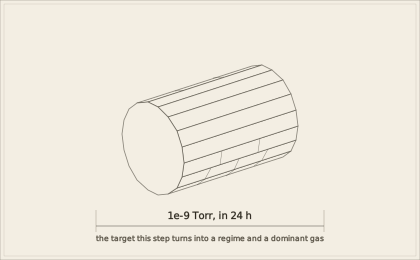 Specify, step 1 of 8 What pressure do I actually need, and by when? A target pressure with no species and no time is not a specification. This step turns a number into a regime, a dominant gas and a horizon, which is what every later step reads.
 -
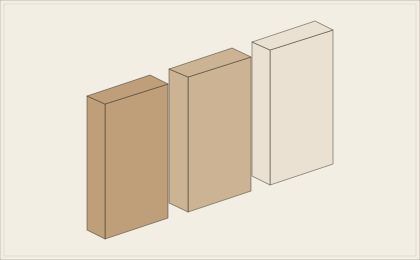 Materials, step 2 of 8 What can the chamber be made of? Every material in the wall is a gas source for the life of the machine. This step reads the card, the sourced outgassing rate and the surface state it was measured in.
 -
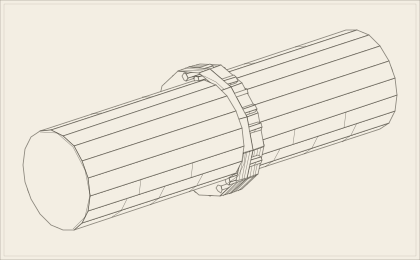 Join, step 3 of 8 How do these two materials become one vacuum wall? A joint is where a chamber leaks, and a ceramic-to-metal joint is where it leaks first. This step reads what a document attests about the couple, before any filler is chosen.
 -
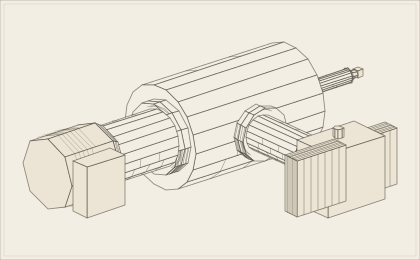 Pump, step 4 of 8 What pumping speed actually reaches the chamber? A pump is sold by its speed at its own flange. What the chamber sees is that speed in series with every tube, elbow, bellows and valve between them. This step computes the difference.
 -
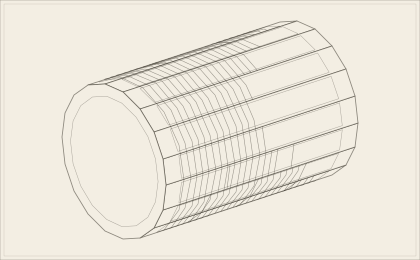 Clean and bake, step 5 of 8 How clean is clean enough, and how do I prove it? Cleanliness has no unit until a specification gives it one. This step reads the cleanliness class, the particle count and the bake that the target pressure demands.
 -
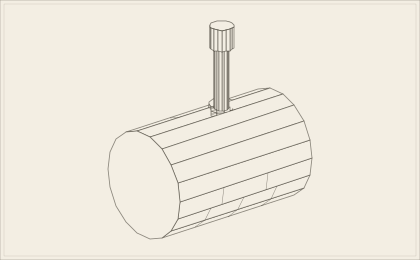 Verify, step 6 of 8 Does the chamber hold, and how would I know? A gauge reads a pressure, an analyser reads a composition, and only the second one tells you what is in the chamber. This step reads both through the abacus.
 -
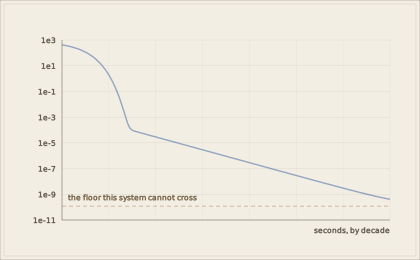 Commission, step 7 of 8 How long until it reaches the number I specified? The pumpdown curve is the first honest measurement a chamber makes. This step compares the predicted curve against the specification set in step one.
 -
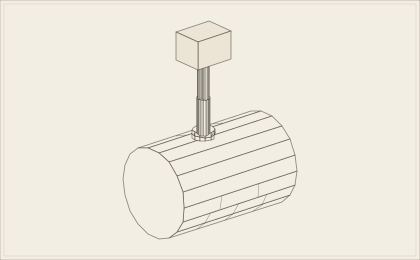 Operate, step 8 of 8 It was fine yesterday. What changed? A machine in service fails in a small number of ways, and each one has a spectrum. This step reads the failure mode from the residual gas rather than from the pressure alone.
From a target pressure to a machine in service. Every step opens on a question an engineer actually asks, then points at what this site already carries to answer it. Nothing is duplicated: the cards, the tools and the modules stay where they are, and a step is the path between them. What a step cannot answer, it says, in a block derived from the corpus rather than written by hand.
The eight plates above are engraved at build by the same drawing engine that runs the builder on step 4. They are vignettes of what a step does, not measurements: the only one that reads real data is the wall section, shaded by the outgassing rates the base publishes for each surface state.
The dossier
A Bill of Vacuum is the document these steps produce: the result you calculated, the source keys it read, and the list of what it had to take on trust. It lives in this browser, with no account, and it leaves as versioned JSON or as a printable sheet carrying its keys and its licence.
The 8 steps point at 26 places across 19 distinct pages of this site, and declare 17 things the base does not carry yet. Both counts are read from the data at build, so they follow the corpus rather than a promise.
About this data
Each step declares what it cannot answer. Here is the whole list, in one place, so the shape of the gaps is visible without opening eight pages.
- Specify
- No pressure specification is stored on this site. The scale, the regime abacus and the monolayer time are read one at a time, and nothing ties them into a document you can hand to a supplier.
- The outgassing base carries 8 speciess. A specification written for a species the base does not carry gets no sourced rate here, and this step says so rather than substituting one.
- Materials
- Join
- The brazing corpus attests 64 sourced pairings across 26 materials. Every other couple the route engine answers for is DERIVED from the model, and the engine marks which is which rather than blending them.
- 40 filler metals are in the corpus. No weld data, no diffusion bonding data, and no elastomer seal data is carried at all.
- Pump
- No pump is in the data. The conductance chain on this page computes what a pumping speed becomes behind a line, and the pumping speed itself has to be typed in from the pump datasheet.
- The bellows conductance has no source in the corpus. A bellows is computed here as a straight tube of the same bore and length, which UNDERSTATES its resistance, and the field says so on its face.
- The elbow correction of 1.3 diameters per bend is a shop rule, carried in formulas.ts under the flag COUDE_ILLUSTRATIF. No source in this corpus publishes it.
- Clean and bake
- No cleanliness class is stored per material or per machine. The essay reads thirty specifications and shows they do not share a unit, which is why nothing here converts one class into another.
- No particle count data is carried. A cleanliness class can be recorded in a Bill of Vacuum as a stated requirement, and it will be marked unsourced until a document backs it.
- Verify
- No gauge accuracy, no calibration interval and no sensitivity factor per gas is carried. The regime abacus says which gauge is VALID at a pressure, not how wrong it is.
- The RGA reference base carries no bibliographic key per mass. Its provenance is per base, in the source drawer of the tool, and no value on that page can be traced to one document.
- Commission
- The pumpdown model reads 258 entries of sourced outgassing and no pump curve at all. A pump that loses speed near its base pressure is not modelled, so a predicted time near the ultimate is optimistic and the calculator says so.
- No commissioning record from a real machine is carried. Nothing here is validated against a chamber that was actually pumped down.
- Operate
- The pump corpus is here, 333 models across 17 families with 3830 sourced parameters, and this step reads it. It also reads what the corpus knows about how those pumps fail: 167 failure modes are servable in English for the model or the family you laid. 125 more are tracked in the same corpus and still written in French in the producing repository, so they are held back rather than machine-translated, because translating a source would be inventing it.
- No service interval, no mean time between failures and no wear model is carried for any component. A Bill of Vacuum built here says nothing about when to service it.