Regimes & Pumps
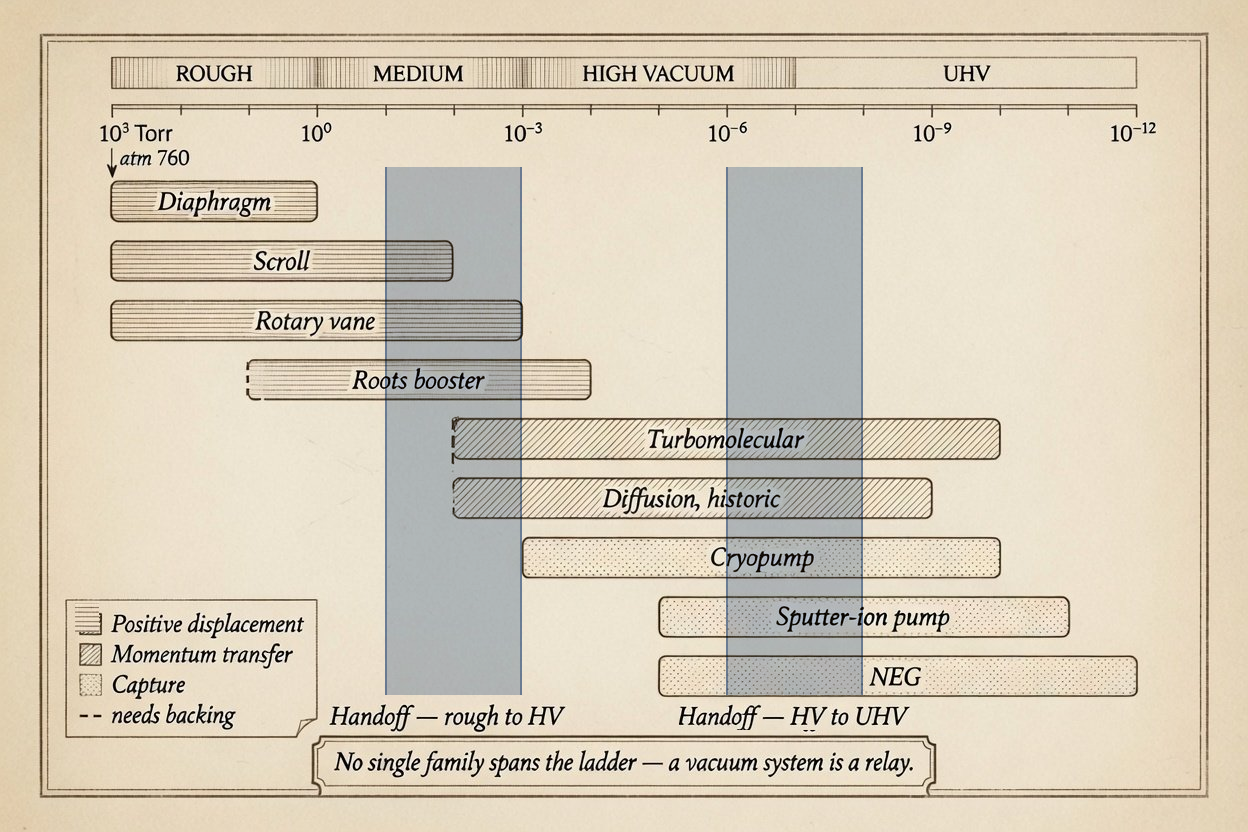
No single pump reaches vacuum. You hand the gas down a chain, pump to pump, across more than fifteen decades, and somewhere in the middle the physics flips under you.
Below about 10⁻³ Torr the gas stops behaving like a fluid. The mean free path grows past the size of the chamber, molecules quit colliding with each other and fly straight from wall to wall. Pumping stops being about moving a fluid and becomes about catching molecules on surfaces, and about how much gas the walls give back. This block is the map, then the pumps.
Pressure in Torr (1 Torr ≈ 1.33 mbar).
| Regime | Range (Torr) | Mean free path | Pumps | Gauges | Seals |
|---|---|---|---|---|---|
| Rough / primary | 760 → 1e-3 | ~0.1 µm → 5 cm | rotary vane, scroll, Roots | Pirani, capacitance | elastomer (Viton), KF/ISO |
| Medium | 1e-3 → 1e-5 | 5 cm → 5 m | Roots + backing, turbo (low) | Pirani, Penning (low) | elastomer or metal |
| High (HV) | 1e-5 → 1e-8 | 5 m → 5 km | turbo, diffusion, cryo | Penning, Bayard-Alpert | metal (CF copper) |
| Ultra-high (UHV) | 1e-8 → 1e-11 | 5 km → 5000 km | ion, sublimation, NEG, turbo | Bayard-Alpert, extractor | metal (CF), bakeable |
| Extreme (XHV) | < 1e-11 | > 5000 km | ion + NEG + sublimation, cryo | extractor | CF, hard bakeout |
The line that matters runs through the middle: below ~10⁻³ Torr you are in the molecular regime, and everything downstream is governed by surfaces and capture, not by sucking on a fluid. [A]
A transfer pump throws gas out of the chamber: rotary vane, Roots, turbo, diffusion. A capture pump traps gas inside itself: ion, titanium sublimation, NEG, cryo. [C]
The capture catch. A capture pump has no exhaust, so it has a finite capacity. It either saturates and stops, or it regenerates. That one fact shapes every UHV system below.
| Pump | Reaches | Note |
|---|---|---|
| Rotary vane (oil-sealed) | ~1e-2 (1 stage), ~1e-3 (2) | oil back-streaming can contaminate |
| Scroll / diaphragm / screw (dry) | ~1e-2 → 1e-3 | oil-free; clean primary, or turbo backing |
| Roots (lobe booster) | ~10 → 0.01 | high throughput, needs a backing pump under it |
All three: [B].
Turbomolecular reaches 1e-9 to 1e-10 Torr on a metal-sealed inlet, ~4e-11 in tandem. A bladed rotor spinning near molecular speed kicks molecules toward the exit; it only works below ~10⁻³ Torr and needs a backing pump on the foreline. Clean, oil-free, fast, it has replaced diffusion in most labs. [B][C] Diffusion reaches below ~7.5e-11 Torr with enormous throughput (10 to 50,000 L/s) and no moving parts; the price is possible oil contamination. Old, mostly displaced by the dry turbo, still unbeaten at very large throughput. [C]
Where transfer pumps hand off and capture takes over.
Sputter ion pump, the heart of static UHV. A Penning discharge, confined by a magnet, sputters a titanium cathode; the fresh film getters reactive gas, and noble gas is pumped by being buried in the cathode. Runs continuously, ultimate into the 1e-11 Torr range and below. [B][A] Field: cathode at a few kV, 3–7 kV field, 1–1.5 kGauss magnet, current-to-pressure 3–25 A/mbar, so the pump current also reads the pressure. Hydrogen is pumped reactively by the film, so the pump stays nearly unsaturated for H₂, 50–100% above its nitrogen speed. [A]
| Element type | Noble-gas stability | Speed vs diode | Note |
|---|---|---|---|
| Diode (Ti cathodes) | poor, “argon instability” | 100% | best vacuum and electrical stability |
| Noble diode (one Ta cathode) | stable | ~80% | Ta buries noble ions deeper; costlier |
| Triode (Starcell) | stable | ~80% | higher start pressure, more noise; long life |
Read the bursts. The diode pump’s argon instability is a signature, not a fault to chase blind: periodic pressure bursts as buried argon is released and re-implanted, climbing a decade or more, then falling on its own. If you must pump argon, run a noble diode or triode. [A]
Titanium sublimation (TSP). A filament sublimes a fresh getter film on the walls; chemisorption. Used below ~1e-4 Torr, bakeable to 400–450°C, always paired with an ion pump. Pumps active gas only, reacts with O₂, N₂, dissociates and diffuses H₂, nothing for noble gases or methane. Sticking probability: H₂ 0.01–0.05, CO 0.4–0.6 at room temperature, higher cold. [A]
Non-evaporable getter (NEG). A getter alloy (St101 Zr-Al, St707 Zr-V-Fe) or a thin film (TiZrV), activated by bakeout, pumping right at the wall, the accelerator coating. Ultimate below 1e-12 mbar; CERN reached low 1e-14 Torr with NEG + TSP + ion pump together. Activation: St101 ~700–740°C, St707 below 450°C, TiZrV film 180°C/24 h (so it works on aluminium chambers). Chemisorbs CO, CO₂, H₂O, N₂, O₂ (O₂ irreversibly); H₂ is reversible. No Ar, He, Kr, Xe. [A]
Always paired. Neither TSP nor NEG pumps noble gas or methane. Every getter system carries an ion pump alongside it to mop up the argon and the methane.
Cryopump. Surfaces at 10–20 K freeze and trap the gas; effective ~1e-6 to 1e-9 Torr, ultimate ~7.5e-10, speed ~1200–4200 L/s. Strong on water and atmospheric gases, weak on helium , hydrogen pumps on the charcoal stage but with finite capacity, finite storage so it must regenerate. [C]
| Need | Reach | Pump |
|---|---|---|
| rough out from atmosphere | 760 → 1e-3 | rotary vane, scroll, Roots |
| high vacuum, clean | 1e-5 → 1e-10 | turbomolecular (+ dry backing) |
| high vacuum, huge throughput | 1e-5 → 1e-10 | diffusion |
| static UHV, all gases | 1e-8 → 1e-11 | ion pump (noble diode for argon) |
| push into XHV | < 1e-11 | NEG + TSP + ion, or cryo |
Below 1e-8, nothing single-handed pumps noble gas, you combine.
Sources · 10
- Regimes, combine technologies, Cornell/USPAS, Yulin Li, Vacuum Science
- Ion pump field / current / element types, CERN, Sputter-Ion Pumps (Schulz)
- Hydrogen pumping, argon instability, arXiv 2006.02721
- TSP sticking, getter pumping, Benvenuti, CERN
- NEG ultimate, 1e-14 with combined pumping, Benvenuti et al., Vacuum
- Rotary vane / Roots / turbo ultimate, Kurt J. Lesker
- Dry pumps, turbo vs diffusion, ion pumps, Leybold
- Triode / Starcell, Agilent, CERN Accelerator School
- Turbo / molecular regime, Ideal Vacuum
- Cryopump figures, Vac Aero
Rated [A] primary, [B] manufacturer, [C] trade (cross-checked). The ion pump rests on primary sources; cryopump round figures are typical orders of magnitude.